Region Overview
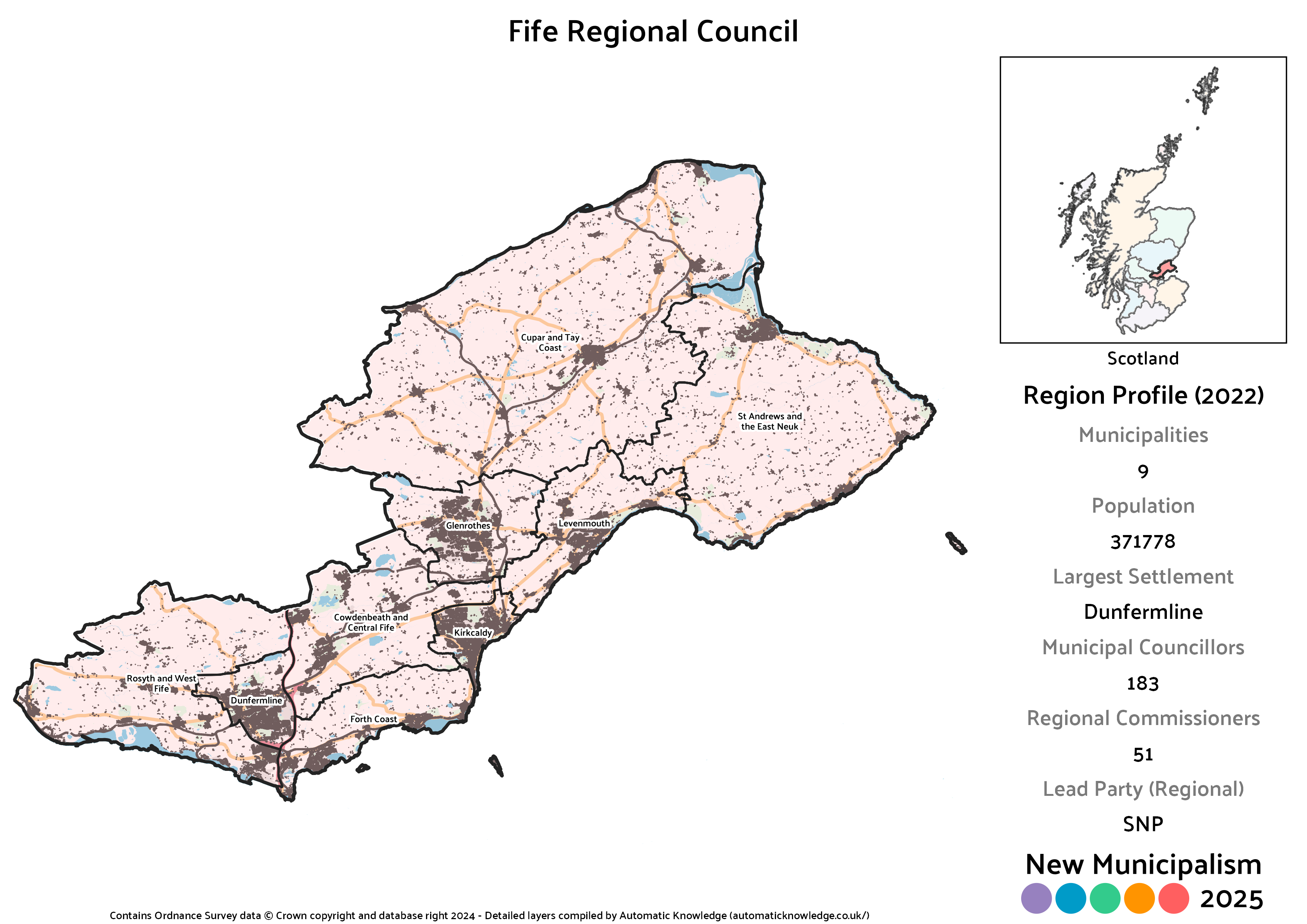
Key Statistics
Municipalities: 9
Population: 371,778
Largest Settlement: Dunfermline
Municipal Councillors: 183
Regional Commissioners: 51
Description
Fife is Fife, as it has always been, and always will be. It’s a brave person who would mess with the overall boundaries of the Kingdom these days. The Wheatley Report which preceded the 1973 Act proposed splitting Fife between multiple regions, and the Government initially intended on doing so when it brought the Bill to Parliament. It was faced with such a massive barrage of criticism from the public and from MPs it eventually relented and gave Fife its own region.
Not only do I not want to incur the wrath of Fifers, who have without a doubt the strongest regional identity anywhere in mainland Scotland, I do genuinely think it makes for a sensible region. That said, the present Fife Council is to urban Scotland what Highland Council is to rural – an absurdly, unjustifiably huge amalgamation of distinct areas that absolutely could and should have their own local municipalities as they would in any other European country, but which also nonetheless make for an obvious wider area to co-ordinate services across.
Although this is therefore a third outing for some kind of Fife-wide administration, after the old County and then the 1973 Act Region, it differs substantially from its predecessors. The old County contained a whopping 25 Burghs, most of them by now very small towns and villages, so that’s not something to emulate. The 1973 Region then went too far in the other direction, with a mere 3 Districts. In plumping for 9 districts, a slight reduction versus my 2020 iteration, I’m hoping I’ve hit the right sweet spot. Distinct Burgh councils for the big towns which should definitely have them, and wider but still compact municipalities for smaller urban areas plus the rural north east.
The fact that Fife is largely urbanised means that overall given recent trends the SNP would be the largest party, with Labour their primary challengers. This pattern would fall apart in the north east however, where it’s instead the Lib Dems not merely challenging but in fact dominating, with nearly two-thirds of their projected seats coming from those two municipalities. That also makes this the only primarily urban region (if we exclude Edinburgh as a unitary) where the Lib Dems place third, ahead of the Conservatives. Although Fife is one of the weaker regions for the Greens, they’ve still got enough presence to justify a seat in most municipalities. Where Fife really differs from every other region is a near total absence of Independents, with only two elected. This reflects the fact that the real Fife Council went Independent-free for the first time in 2017 and remained so in 2022.
Projected Overall Municipal Election Results (2022)
Votes
Seats
Projected Overall Regional Election Results (2022)
Votes
Seats
Note: Bear in mind that for the regional results on an individual municipality basis below, the final seat is allocated from a region-wide levelling process. This means that whilst the distribution of seats is correctly proportional across the whole region, that is not necessarily the case in an individual municipality. The party that won each municipality’s levelling seat is marked by an asterisk * next to their name on the Votes chart.
Cowdenbeath and Central Fife District
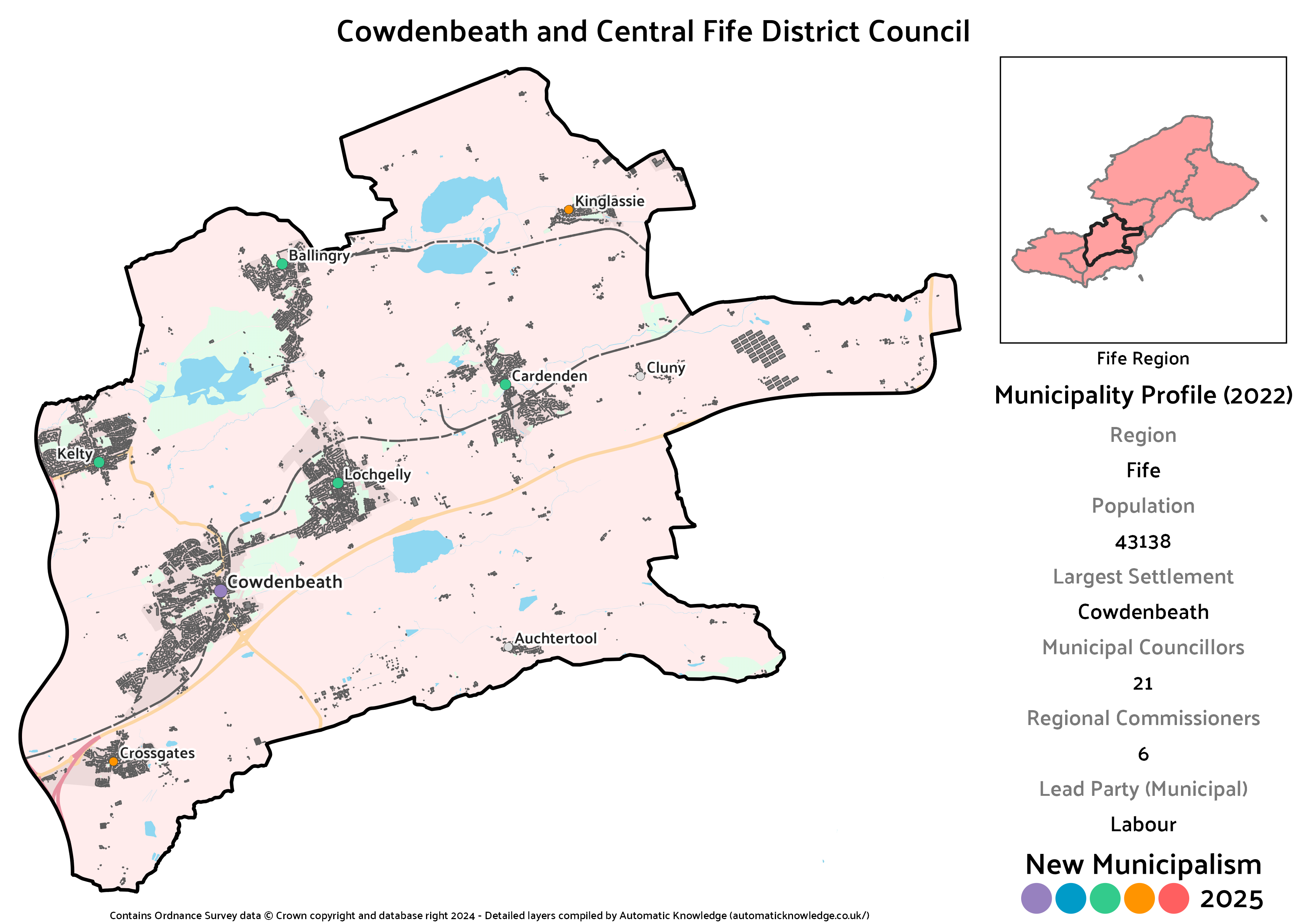
Key Statistics
Population: 43,138
Largest Settlement: Cowdenbeath
Municipal Councillors: 21
Regional Commissioners: 6
Description
Cowdenbeath and Central Fife acts as a catch all for the parts of Fife which are neither large towns in their own right nor do they have a coastline. In addition to Cowdenbeath itself, that includes Crossgates, Kelty, Lochgelly, Cardenden, Ballingry, Kinglassie and Auchertool. Although the latter is very small, it represents a slight change from the 2020 iteration, where it had been an awkwardly disconnected inland part of the Forth Coast district.
Labour have weathered recent national storms comparatively well at all levels here, perhaps fitting for an area largely within the former seat of the second most recent Labour Prime Minister. That gives them a lead in votes over the SNP, though it’s so slender it doesn’t give them any seat advantage. Note too the levelling mechanism gives the SNP an extra regional seat over what Labour get. As the only other party with any seats at all would be the Conservatives, in a sense this is the most boring municipality in the region. Feeble results for the Greens and Lib Dems mean there’s nobody else that’d make it in, this being the only Fife municipality with no projected Lib Dem.
Projected Municipal Election Results (2022)
Votes
Seats
Projected Regional Election Results (2022)
Votes
Seats
Cupar and Tay Coast District
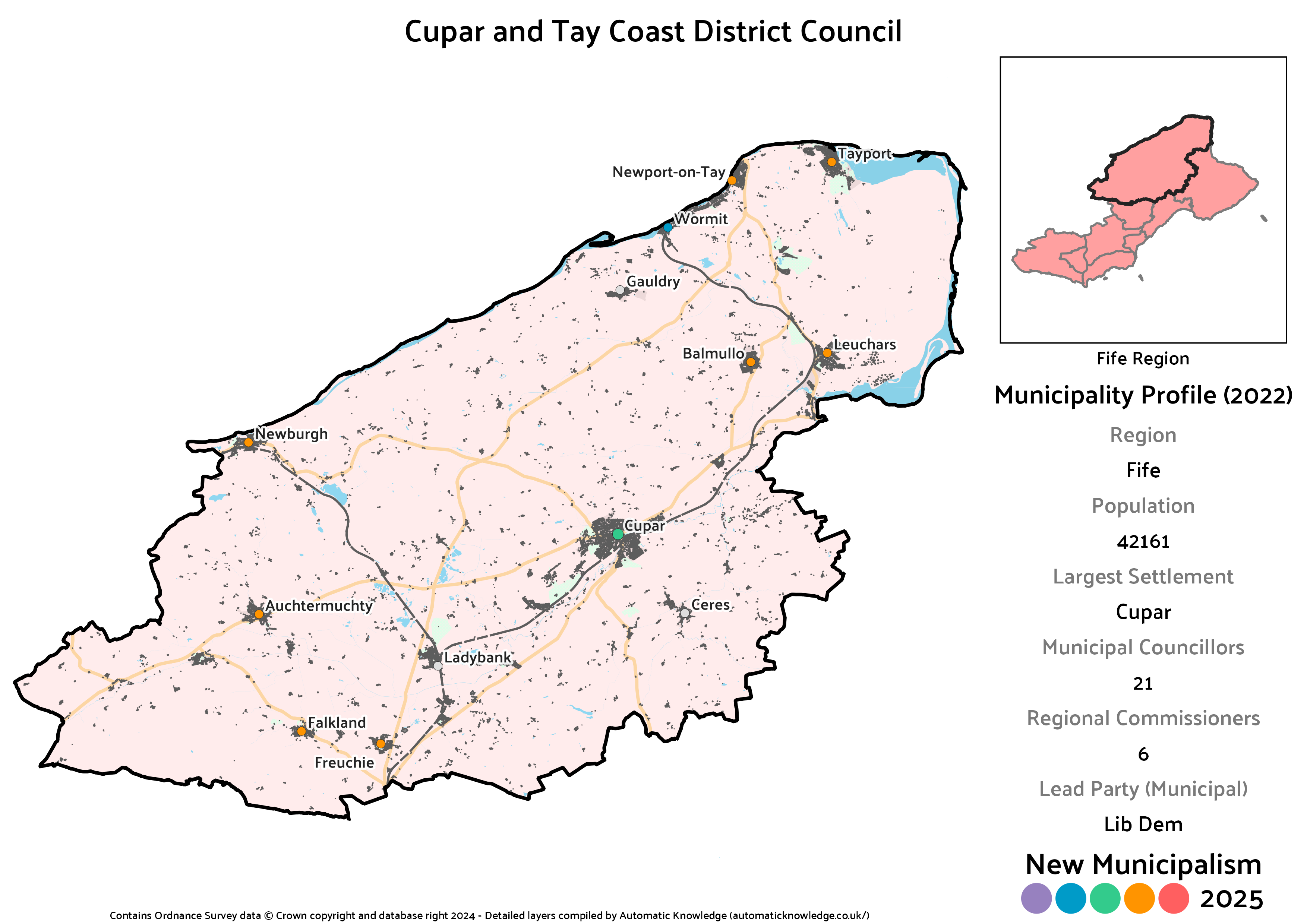
Key Statistics
Population: 42,161
Largest Settlement: Cupar
Municipal Councillors: 21
Regional Commissioners: 6
Description
Renamed from “North Fife” in the previous version, to give it a little bit more character, that’s the only difference for Cupar and Tay Coast. I had tried to see if I could split it into two components, an inland Howe of Fife centred on Cupar and a Tay Coast stretching from Newburgh to Leuchars, but I couldn’t quite get the numbers to fit. This perhaps works perfectly fine as it is, given it still represents a much more compact unit than the current Fife unitary. Although Wormit, Newport-on-Tay and Tayport are often seen as Dundee commuter villages by this point, which would have seen them annexed to the city in the reviled Wheatley Report proposals, there’s no way I’m putting myself in the firing line for that one here.
Based on 2022 results, the Lib Dems are so dominant here that this would have the distinction of being one of just two municipalities in the country to have a single party majority, and the only one where that happens without a majority vote share too. The unsurprising counterweight to that Lib Dem strength is that this is the second weakest part of Fife for the SNP and Conservatives, and weakest for Labour. By contrast it’s the second best for the Greens, which places them ahead of Labour and lands one of the regional commissioners.
Projected Municipal Election Results (2022)
Votes
Seats
Projected Regional Election Results (2022)
Votes
Seats
Dunfermline City
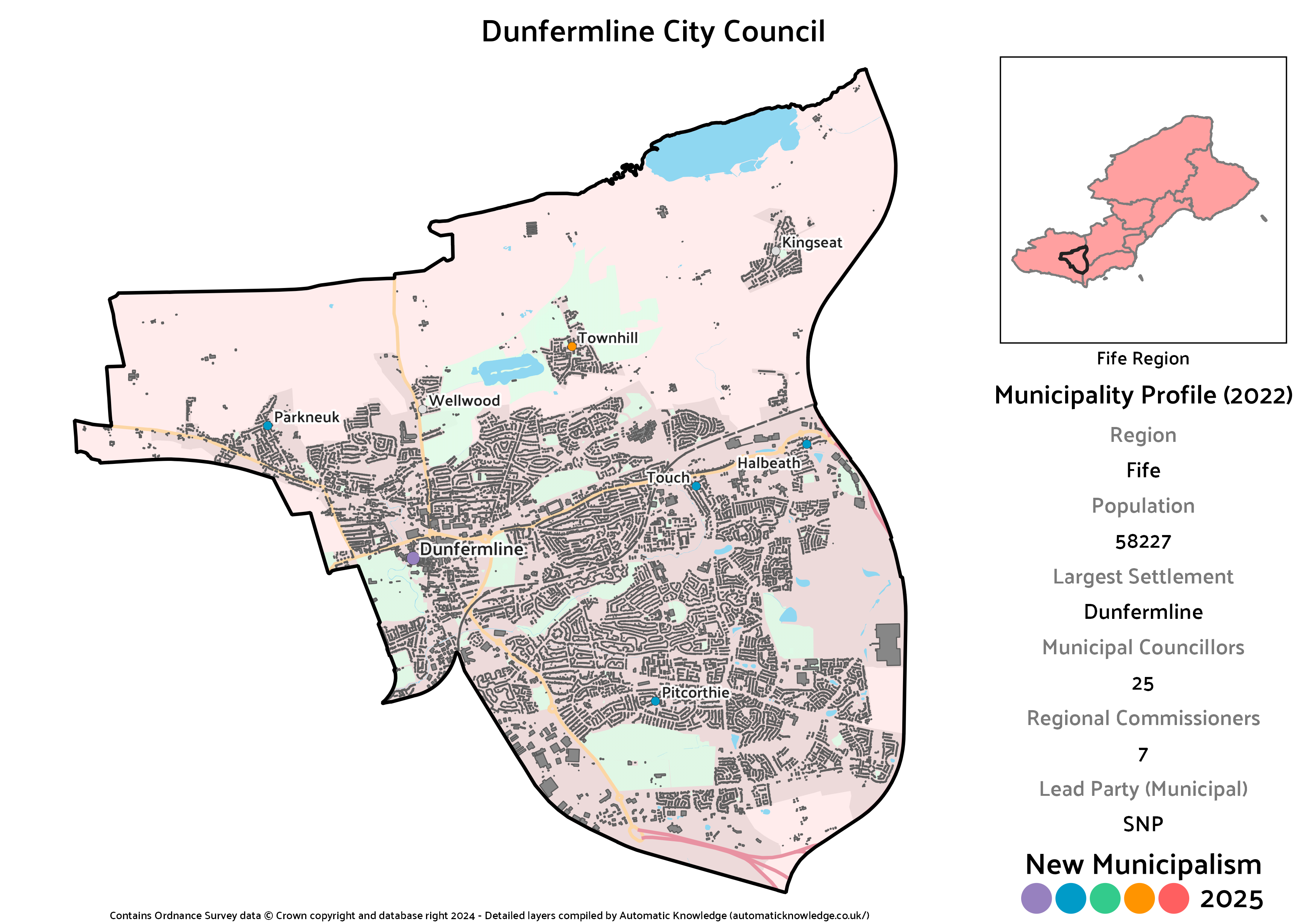
Key Statistics
Population: 58,227
Largest Settlement: Dunfermline
Municipal Councillors: 25
Regional Commissioners: 7
Description
Dunfermline is the most recent settlement in Scotland to have been granted the currently completely meaningless bauble of “City Status”, being presented with it for the previous monarch’s Platinum Jubilee in 2022. By Scottish standards Dunfermline is a very big town and it was already absurd that it didn’t have its own burgh councils – giving it the title of “City” without any attached governing powers just makes that even worse. In addition to Dunfermline itself, the villages of Townhill and Kingseat which are clearly within its orbit are also bolted on. Notably however it doesn’t include Rosyth, which was within the bounds of the pre-1973 burgh but has a very sizeable population of its own.
In political terms, the city actually ends up almost perfectly representative of the wider region. It’s got an SNP lead with Labour in second but not a million miles behind. It’s got the Lib Dems in third, their best result in Fife outside their strongholds in the north east, rooted in historic strength in the city. The Conservatives aren’t particularly strong but nonetheless perform solidly, and there’s a decent Green result. Joining the five core parties though is one of only two Independents in Fife, with Martin Willcocks having stood unsuccessfully in Dunfermline South in reality but making it over the line here. It also has at least one regional commissioner from each of the parties.
Projected Municipal Election Results (2022)
Votes
Seats
Projected Regional Election Results (2022)
Votes
Seats
Forth Coast District
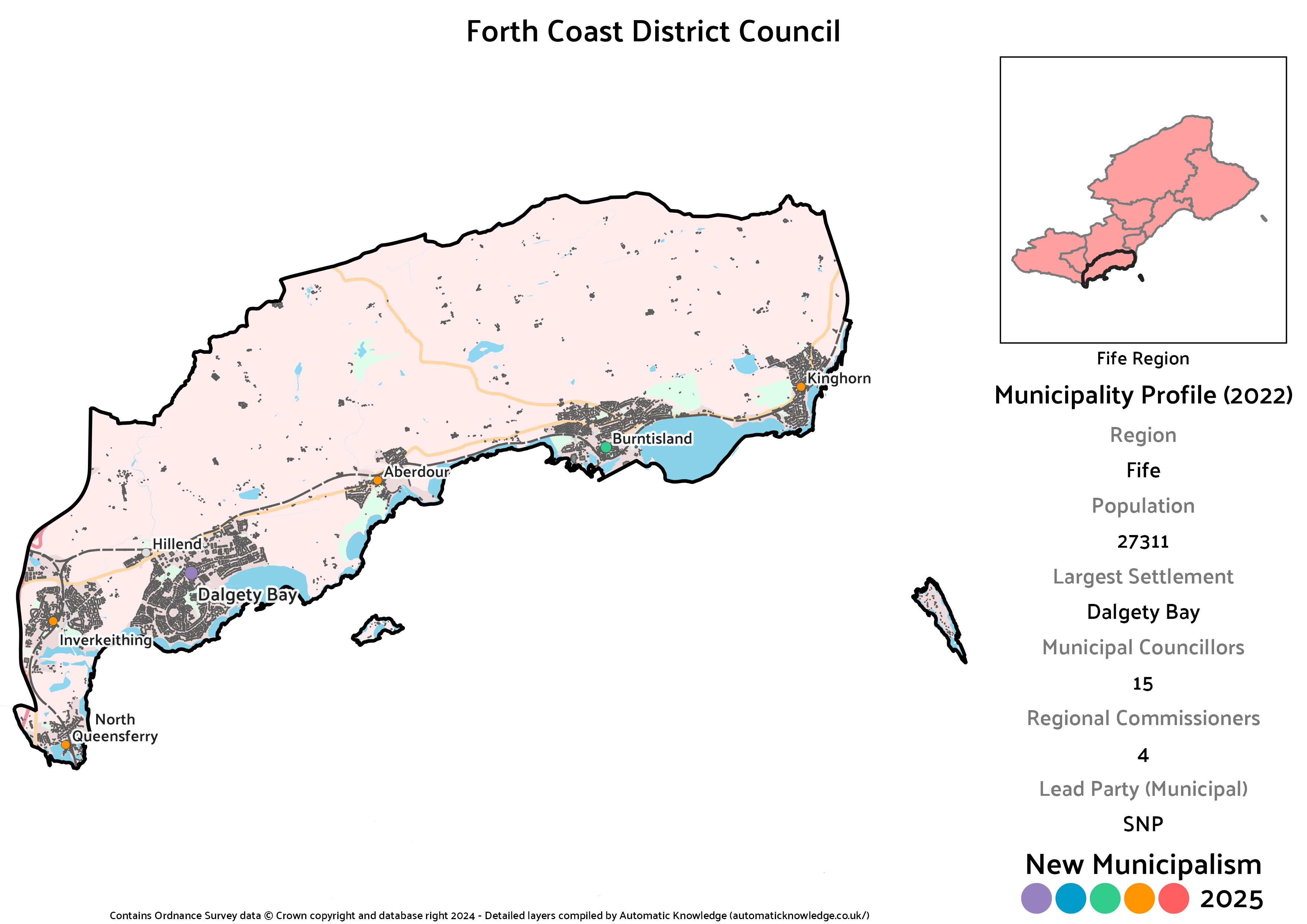
Key Statistics
Population: 27,311
Largest Settlement: Dalgety Bay
Municipal Councillors: 15
Regional Commissioners: 4
Description
Forth Coast encompasses the string of coastal towns and villages in between Dunfermline and Kirkcaldy, including Kinghorn, Burntisland, Aberdour, Dalgety Bay, Inverkeithing and North Queensferry. The last two are additions versus the 2020 version of this project, when they’d been within a Rosyth and Inverkeithing Burgh. This time around I split that, as it was a bit undersized and I felt the motorway made for a natural albeit very modern dividing line. It also loses Auchertool, a tiny inland village that had crept in last time but makes more sense elsewhere.
Though the SNP would have a clear lead on the municipal council, Forth Coast is notable as the only bit of Fife where the Conservatives come in second. That naturally makes it their best area, and the worst for Labour outside of North East Fife, though still with a respectable share. Although this is the best part of the region for the Greens, the quirks of the levelling seat system means it’s the SNP picking up the last regional seat here.
Projected Municipal Election Results (2022)
Votes
Seats
Projected Regional Election Results (2022)
Votes
Seats
Glenrothes Burgh
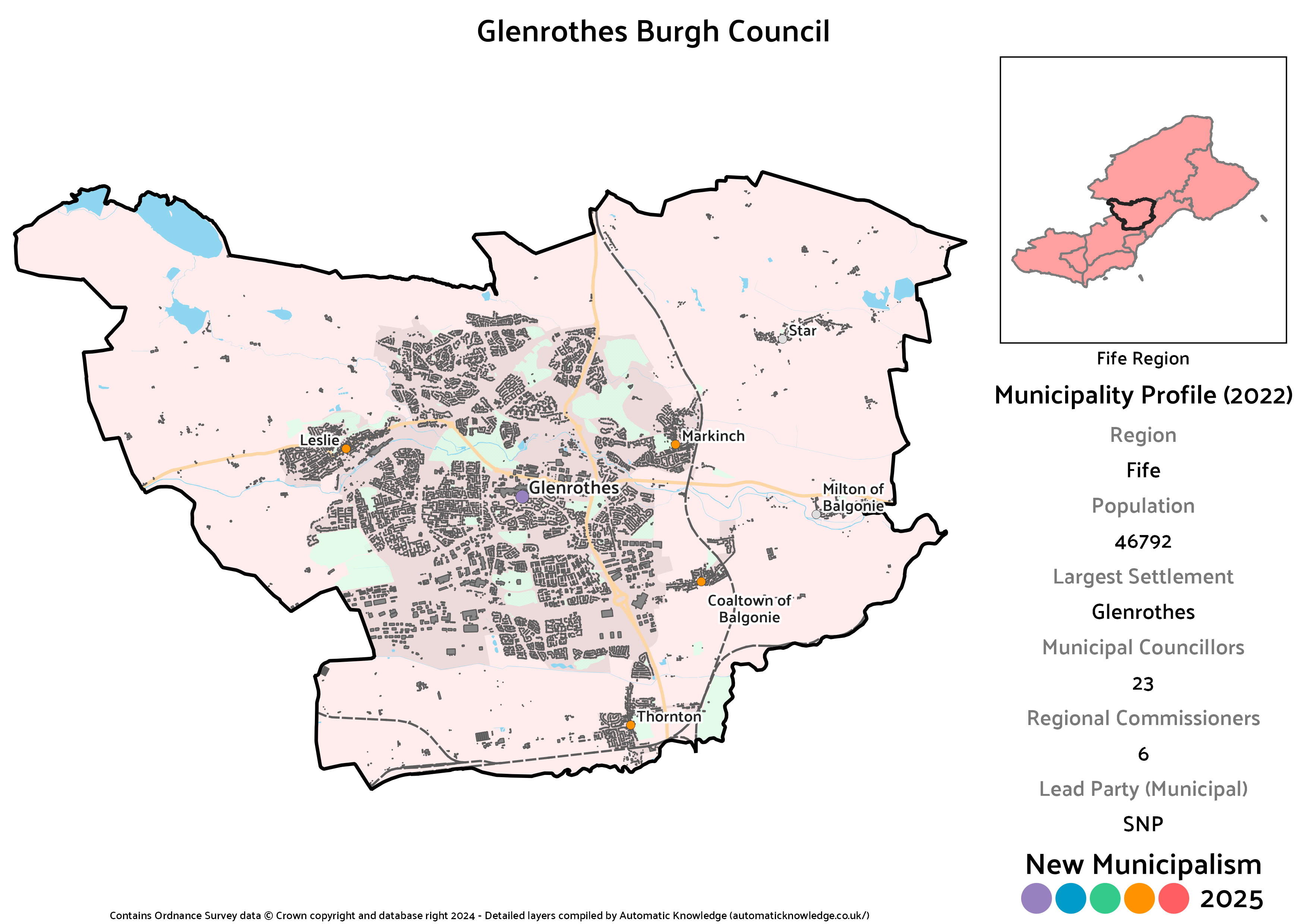
Key Statistics
Population: 46,792
Largest Settlement: Glenrothes
Municipal Councillors: 23
Regional Commissioners: 6
Description
Though Fife continues to claim for itself the ancient title of “Kingdom”, the current administrative hub at Glenrothes is a thoroughly modern creation as one of Scotland’s post-war New Towns. Although Glenrothes itself is a bit smaller than the longer-established Dunfermline and Kirkcaldy, it’s still easily the third largest settlement in Fife, and the population of this wider burgh is padded out through the inclusion of a number of satellite villages. Leslie, Markinch (both historic burghs themselves), Thornton and Coaltown of Balgonie are all pretty directly attached to the core, whilst Milton of Balgonie and Star are a little further out. Changes here versus the 2020 version are purely cosmetic, making greater use of natural boundaries.
Glenrothes has been a real stronghold for the SNP in recent years, and that’s reflected in a pretty commanding lead in the imagined burgh council. They fall only a single seat short of a majority, which could be granted by the single Green. Labour would have a similarly strong lead over the Conservatives in third, and much like the Greens, the Lib Dems would have a comparatively feeble result here, but sufficient for a seat nonetheless.
Projected Municipal Election Results (2022)
Votes
Seats
Projected Regional Election Results (2022)
Votes
Seats
Kirkcaldy Burgh
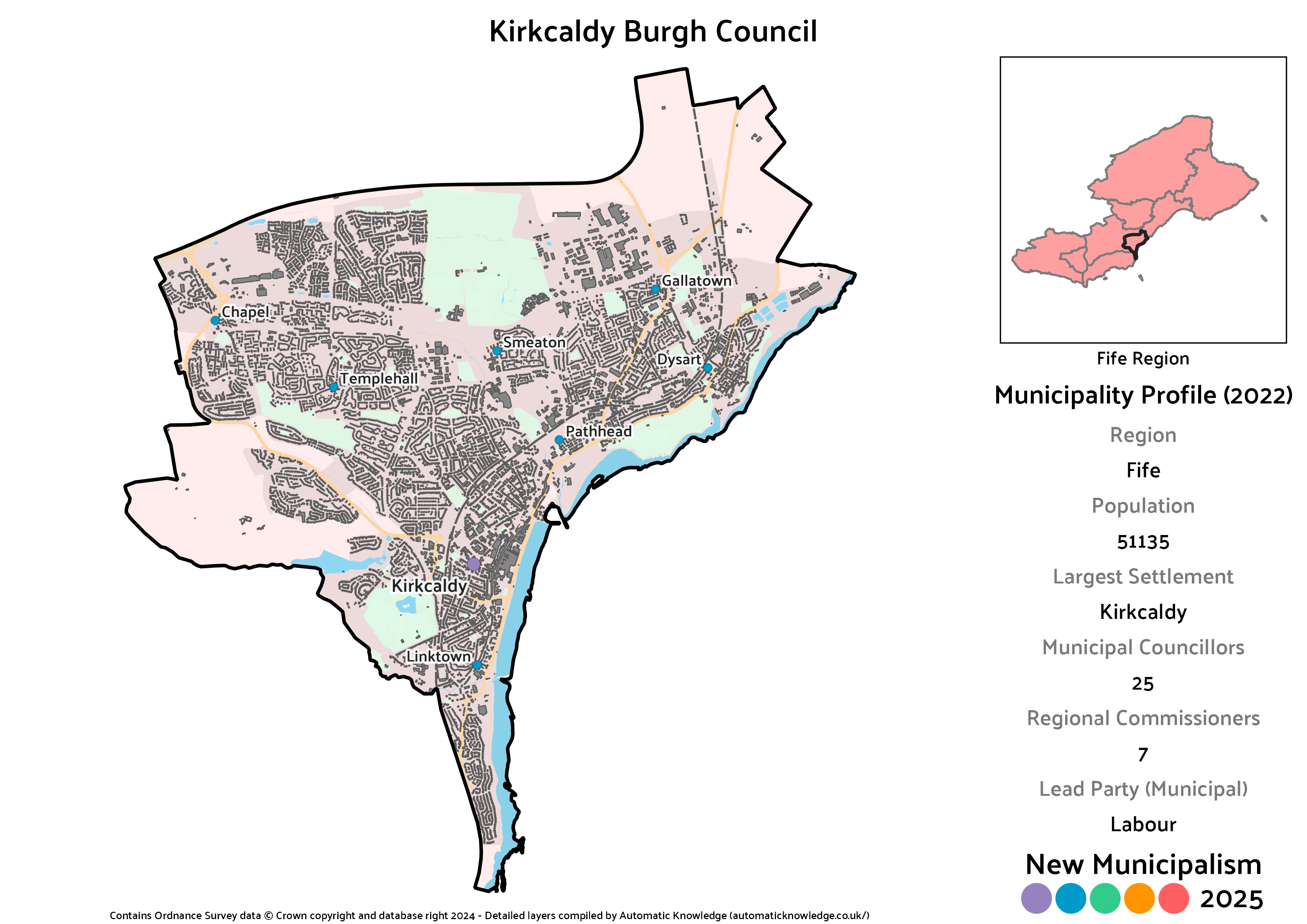
Key Statistics
Population: 51,135
Largest Settlement: Kirkcaldy
Municipal Councillors: 25
Regional Commissioners: 7
Description
Kirkcaldy is one of the many classic examples of a big town that should be locally self-governing but under out current absurd model isn’t. It should have a burgh council, and in this project it does. Feels like there’s not much else to say about this one then, seeing as it’s the same as in 2020!
Turning to the political balance, this is the other component to Gordon Brown’s historic stomping ground, and thus one of the two Fife municipalities to see Labour squeak a narrow lead over the SNP. Here, that’s good for a lead in seat terms too, and leaves the Conservatives a very distant third. The Greens and especially the Lib Dems don’t have a massive amount of support here but do cross the threshold, barely in the latter’s case, and so take a seat each.
Projected Municipal Election Results (2022)
Votes
Seats
Projected Regional Election Results (2022)
Votes
Seats
Levenmouth Burgh
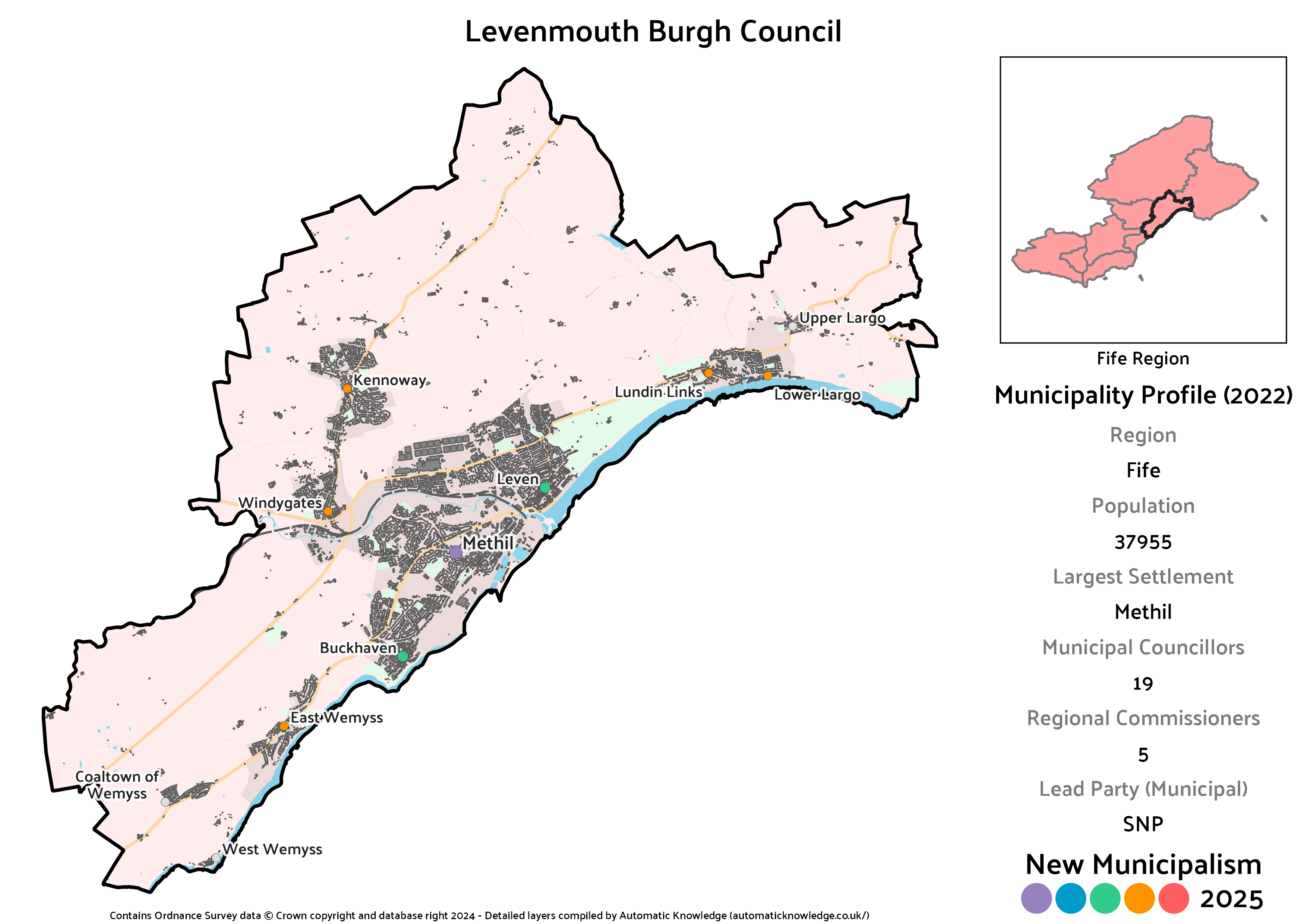
Key Statistics
Population: 37,955
Largest Settlement: Methil
Municipal Councillors: 19
Regional Commissioners: 5
Description
As the name would suggest, Levenmouth covers a cluster of towns and villages where the River Leven meets the Firth of Forth. The core cluster here around Leven, Methil and Buckhaven is so substantially well-knitted together that I opted to give this one a Burgh designation, although it also contains the neighbouring Wemyss villages, Kennoway, Windygates, Lundin Links, and the Largos (Upper and Lower). Part of the area’s claim to fame in recent years was that it was the largest urban agglomeration in Scotland not to have a direct rail link, but a very shiny new branch line and stations have quite literally put them on the map again.
Part of one of the SNP’s brightest patches in Fife for quite some time, this would be their second best municipality in the region. It would also be one of Labour’s higher shares, with Lib Dem strength in Lundin Links and the Largos (part of their North East Fife heartland at Westminster even before recent boundary changes) giving them a perhaps surprisingly high share given the overall demographics here. On the other hand this would be the weakest part of Fife for the Conservatives, although they’d still easily win seats, and the Greens, who wouldn’t.
Projected Municipal Election Results (2022)
Votes
Seats
Projected Regional Election Results (2022)
Votes
Seats
Rosyth and West Fife District
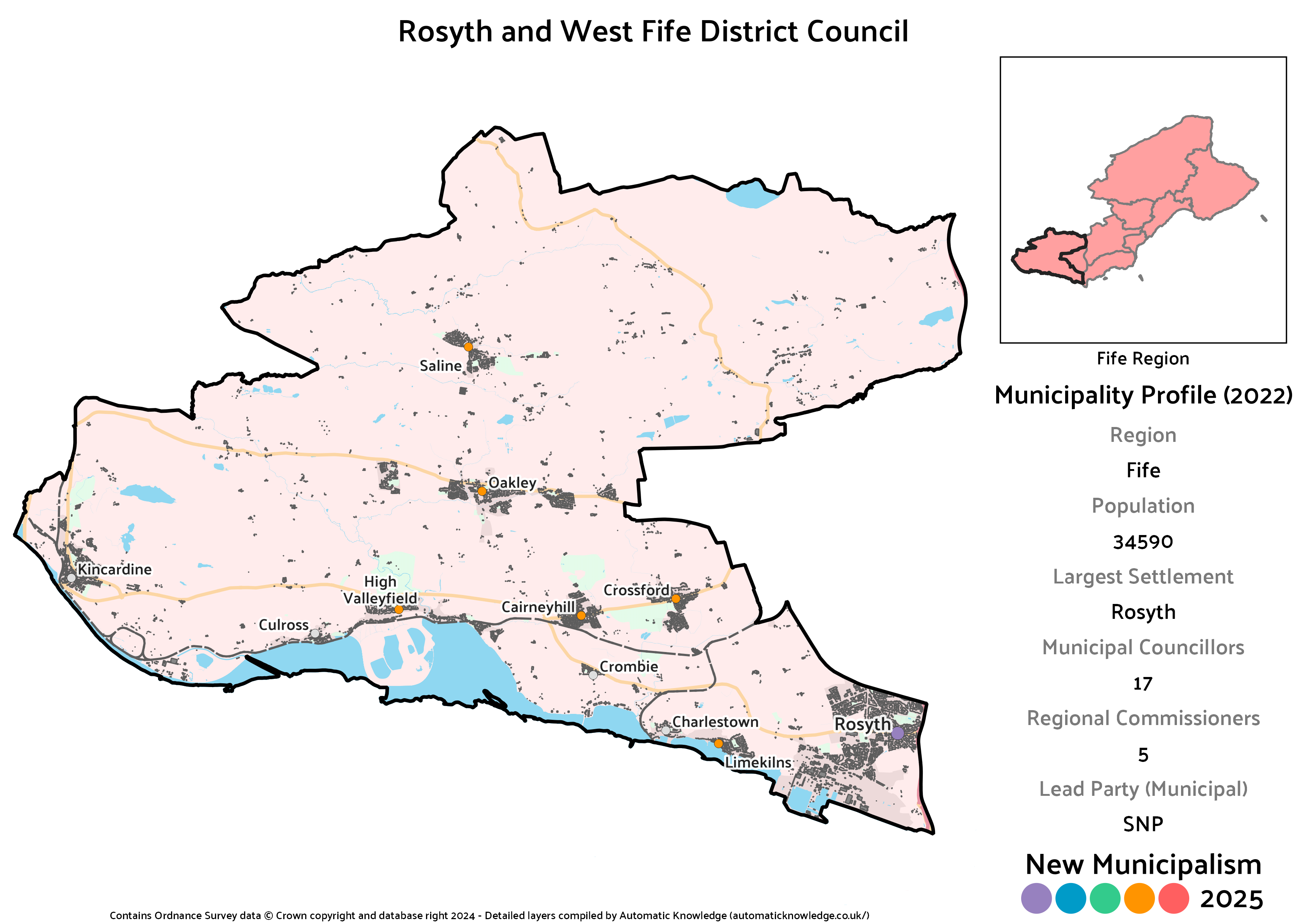
Key Statistics
Population: 34,590
Largest Settlement: Rosyth
Municipal Councillors: 17
Regional Commissioners: 5
Description
This is the other side of the biggest change within Fife versus my 2020 proposal – with Inverkeithing having gone to a redrawn Forth Coast, Rosyth gets paired with the west Fife villages. That also represents a bit of a break with history, as Rosyth had formed part of the old Dunfermline Burgh. I’ve kept it broken off here, despite that reconfiguration versus my 2020 model, simply in the interests of keeping things more local. The villages are too many to list in full, most having roots as mining villages in the heyday of the Fife coalfield.
The SNP would be the largest party here based on 2022 results, though of the municipalities where they are leading Labour, it is the narrowest gap between the two. For the Conservatives it would be their second strongest part of Fife, the Lib Dems manage to squeak into double figures due to Crossford having been chiselled off of a Dunfermline ward, leaving the Greens with one seat to round things out. It’s also worth noting that this is the closest Alba come to a seat in Fife.
Projected Municipal Election Results (2022)
Votes
Seats
Projected Regional Election Results (2022)
Votes
Seats
St Andrews and the East Neuk District
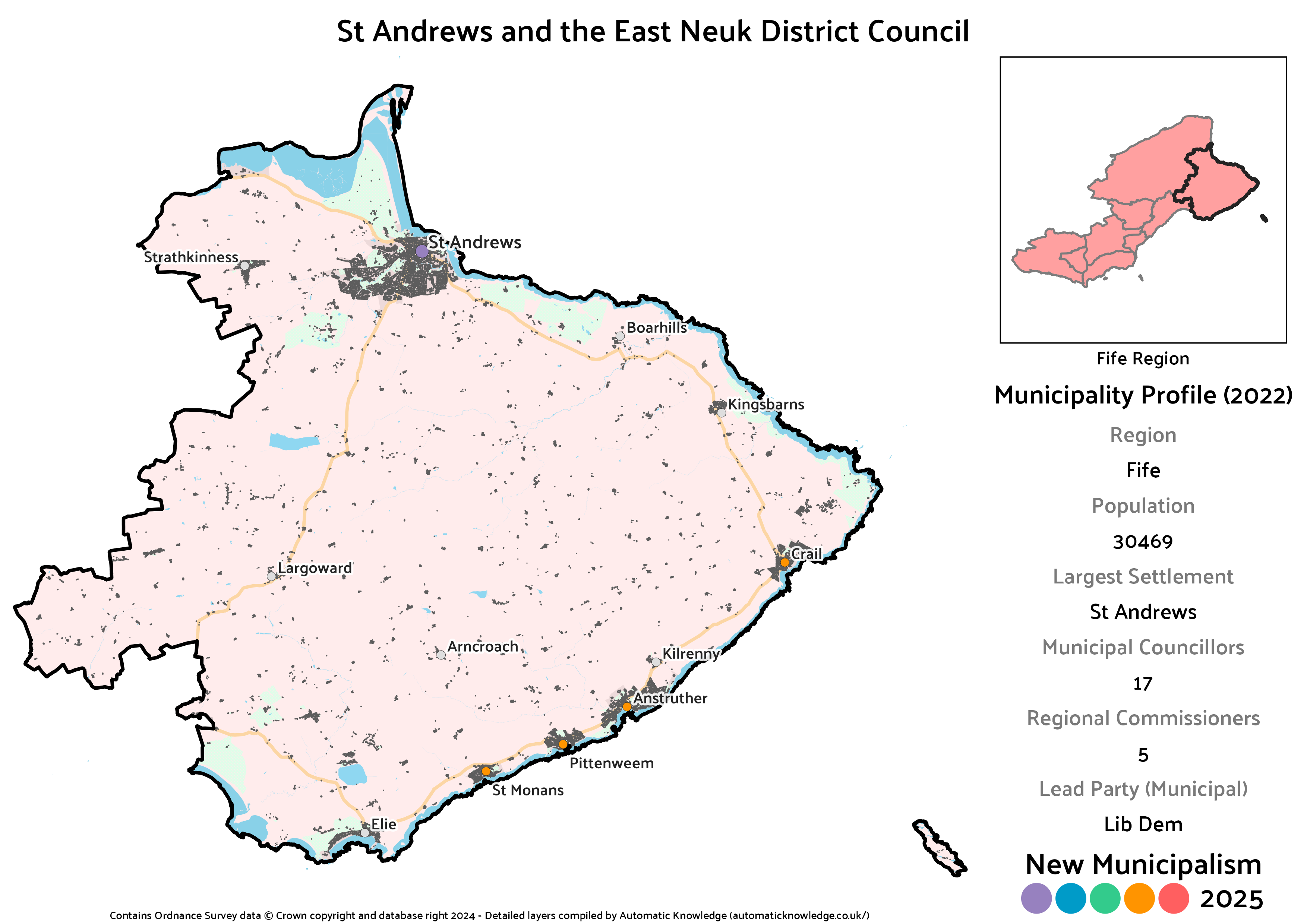
Key Statistics
Population: 30,469
Largest Settlement: St Andrews
Municipal Councillors: 17
Regional Commissioners: 5
Description
The other half of the North East Fife area, St Andrews and the East Neuk combines one of Scotland’s most weel-kent University towns with a string of tiny yet historically important villages along the coast. Despite their size all of these villages, stretching from Elie to Crail, once possessed burgh status, probably due to the importance of fishing to an island nation. Although the pairing of University town and coastal villages may be slightly odd, it’s at least a less awkward one than tying this area to urban south Fife as the current unitary model does.
Part of one of the Lib Dems’ remaining impenetrable strongholds, they’d only be a single seat short of a majority and thus have the pick of whoever they wanted to work with on any given issue. For the SNP though this is their weakest Fife municipality, and a middling one for the Conservatives who are the only other party to win more than one seat. The Greens narrowly lead Labour in votes, and this would be the other of only two Fife municipalities with an Independent councillor in the form of Linda Holt, who in the real world was elected for East Neuk and Landward in 2017 as a Conservative but unsuccessful as an Independent in 2022.